
CRITICAL ANGLE
OPENING QUESTIONS:
-
Please write down Snell's Law in it's 'usual' form.
-
Please now write down the formula that allows us to calculate the index of refraction of a material
- Now please work with your group to use those formulae to *derive* an equation that will allow you to calculate the speed of light in a particular medium
═══════════════════════════
LEARNING TARGET: I will be able to describe 'critical angle' to an articulate 12 year after today's class.
CALENDAR:
| 7:30-8:15 1st period (45 minutes) |
| 8:20-9:05 2nd period (45 minutes) |
| 9:10-9:55 3rd period (45 minutes) |
10:00-11:00 4th period (60 minutes) Yearbooks will be delivered during 4th period. |
11:05-12:20 Common lunch and signing party (75 minutes) All students will have the same extended lunch |
| 12:25-1:10 5th period (45 minutes) |
| 1:15-2:00 6th period (45 minutes) |
FORMULAE OBJECTUS:
θi = θr Angle of incidence = angle of reflection
c/v = n Index of refraction
Snell's Law: n1sin Θ1= n2sinΘ2
LEARNING TARGET: I will be able to calculate the critical angle for an incident light ray during today's class.
WORDS O' THE DAY:
- medium (material through which light is traveling)
- Reflection ("Light waves bouncing off an object")
- Emission ("Light is given off by an object")
- Absorption ("Some wavelengths of light are absorbed by an object")
- Refraction ("Light bending as it changes medium")
- Angle of Incidence ("The angle a light ray takes as it moves toward a reflecting surface")
- Angle of Reflection ("The angle a light ray takes as it moves away from a reflecting object")
- Retroreflection ("incident light waves are 'double bounced' back to the observer, regardless of the angle of incidence")
- Critical Angle: ("The angle {θc} where light is TOTALLY internally reflected")
WORK O' THE DAY:
═══════════════════════════
Last Week's Practice problems:
Please review my solutions below
1) The index of refraction of isopropyl alcohol is 1.38. If a light ray in air is incident at 27 degrees at the surface of isopropyl alcohol, what angle of refraction results?
2) A flashlight is shown upwards towards the surface of water (n = 1.33) at an angle of 18 degrees to the normal line, what angle does it make in air?
3) A flash light is shown through air upon an unknown liquid at an incident angle of 21 degrees to the normal. The resulting angle of incidence tells you the substance is benzene with an index of refraction of 1.50. What was the angle of refraction in benzene?
4) Consider problem #3. A light ray shown upwards from benzene into air would bend...
- towards the normal (perpendicular) line?
- Away from the normal (perpendicular) line?
- Be fully reflected back into the benzene? (this is kindofa trick question)
═══════════════════════════
Now let's take a look at THIS in light of our new "Work O' the Day": "Critical Angle"
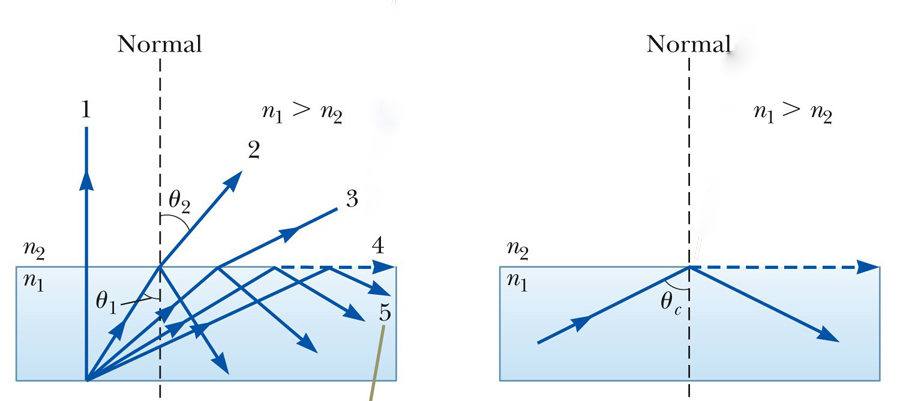
What happens when light is incident at an angle >= θc??
Please now grab a set of laser pointers and a some glass or other material and see how precisely you can measure the critical angle for that substance -- then go and do a wee bit of research and see how close you were.
What conditions MUST exist for θc to exist?
There is NO critical angle when shining a lot from n2 into n1 above. Why is that?
Now please research the critical angle for diamond.
Now please find one of the various types of shapes or 'cuts' that diamond sellers utilize to capitalize on the critical angle for diamond. Sketch that on a large-ish piece of paper and show how light can get 'captured' inside the diamond and what happens then!
═══════════════════════════
With those thoughts in mind, let's revisit problem #2.
At what incident angle does light become totally internally reflected and does NOT leave the water (in other words, what is the critical angle for light moving from water into air?)
How do we know?
Is there a similar angle from air to benzene?